Thank you to Alex Webb for writing this brilliant guest blog for us! You can find more about Alex’s business here.
So, you’ve got your new logo, your brand is smart, looks great on the website, in your marketing material and across your social media platforms. You’ve spent time and attention on understanding the values of your company and what they portray to your clients. So, what’s next?
How do you connect your brand values to those of the values of your employees? Why does this matter?
Values
Values are there to give us direction, help us make decisions and guide our behaviour, creating an impact on our colleagues and also to our clients/ customers. So how are you communicating your values to your colleagues? How many times do you use your company values when sharing ideas, making change or when pressure rises? It is important to bring these values to life, they should not lie dormant on your ‘About us’ website page or a decorative piece of art on the office wall that doesn’t actually play out in the walls of the building.
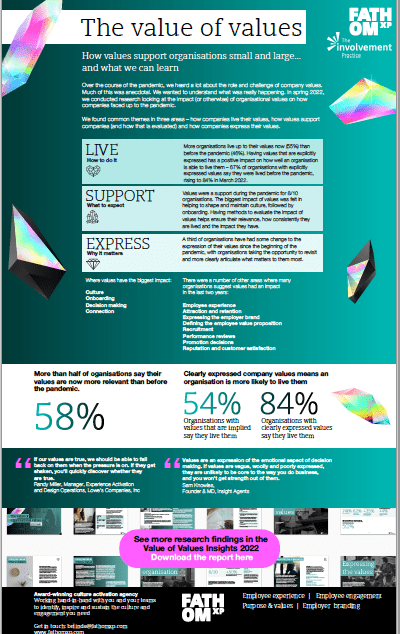
Research led by Employee Engagement Company, FathomXP, highlights that having company values has the biggest impact on :
- Culture
- Onboarding
- Decision making
- Connection
- Recruitment
- Retention
FathomXP’s research shows that organisations who clearly express their values, say they live them (84%) and those organisations that only imply their values, say they live them (54%)
We know how important it is to support the communication of these values, however large or small your organisation is. Helping individuals connect their own personal values to those of the company is key as it will increase buy-in and willingness to perform.
When we talk about personal values, we mean the values from which you live your life. These values come from your past experiences, your family and your background. When these are not respected, it feels like someone has kicked you in the stomach or trodden on your favourite personal possession. If you have experienced this your will understand the importance of values.
Story
I was working with a client 2 years ago, they had just left their workplace due to burnout. They had loved their work, which they’d been doing for 16 years, but it was now getting too hard. They would drop in and out of depression and found daily tasks difficult, something that used to come so easily to them such as making decisions, moving at pace and leading a team.
When we started our work on their personal values, it was so clear to see that their core values were at odds with the values of the company they worked for. This understanding made them realise that it wasn’t them that was the issue, it was the environment they were in. A huge weight was lifted, as they started to search for a company where their values matched in a more positive way.
However hard you work, if you are not able to live your values on a day-to-day basis, you will become de-energised, which in turn will stop you being your best.
Company Culture
The values of a company lie at the heart of the company culture,
Company Culture Definition:
Company culture is how you do what you do in the workplace. It’s the sum of your formal and informal systems, behaviours and values, all of which create an experience for your employees and customers. At its core, company culture is how things get done around the workplace
The adage that ‘Culture eats strategy for breakfast’. highlights that it is more important how you will achieve, rather than what you would like to achieve.
Company culture has values at its core. It’s the values which then support the expected behaviours of an organisation, the ‘how you will achieve it’ part.
Imagine an iceberg.
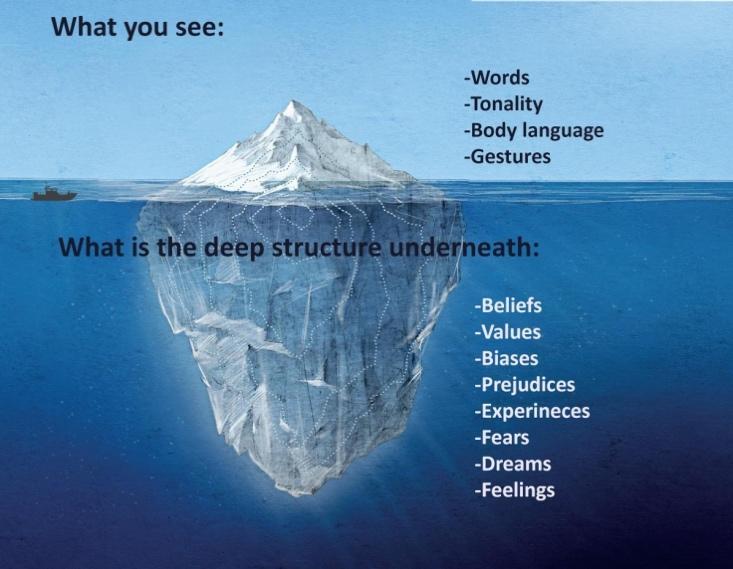
Above the water line is what we can see from others, this equates to our behaviours. The words we use, the tonality, the body language and gestures.
It is our behaviours that impact others, whether that is our clients, customers or our peers.
What you See
If you’ve spent the time looking at your company brand, you will have undoubtedly thought of tonality and words. Have you thought about how this is matched with the behaviours of those in your company? What are your expectations? How do you live your values through the behaviours of those who are representing your company and brand? Are these linked with your Mission?
Another key component of the makeup of the company culture is the behaviour within it.
We generally judge other people on their behaviour, because it’s all that we see. However, we judge ourselves on our intentions. We are conscious of our decisions and therefore know why we behaved in such a way. An example being:
Is it common to judge a fellow driver badly for cutting us up? But when we do the same, because our intention is to ensure we are not late for picking up our child from school, it is acceptable.
So, our behaviours, i.e. what others see, become incredibly important because this is how we impact the outside world, our friends, our family, our clients and peers.
What we don’t see
If we look underneath the water line of our iceberg, this is where our values sit. Our beliefs, our biases, our prejudices and fears. These are only seen by those who do a deep dive, who take the time to understand us and to connect. Sometimes these areas are not even known to those that hold them, because they don’t have this self-awareness.
Working with individuals, teams and companies to increase this awareness is one of the most important areas of the work we can do. Because our belief is that:
- a strong leader is an aware one
- a strong person is an aware one
- a strong teammate is an aware one
- a resilient individual is an aware one
Whether you are a company just starting up, going through change, or are consistently performing, building this awareness in your individuals and teams, knowing your values, your behaviour preferences, your strengths and your weaknesses, will undoubtedly lead to a stronger company culture, a feeling of belonging.
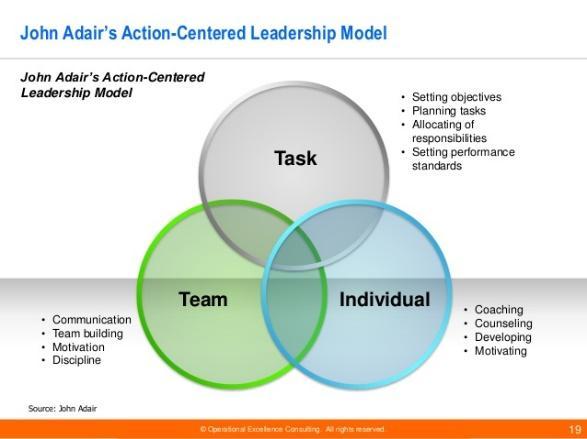
As John Adair highlighted in his Action Centered Leadership Model, if you only focus on task and productivity, with no balance of focus on individuals and the team, you will sink.
Are you supporting your individuals and teams, to build a stronger brand for your company, allowing your values to be clearly seen in everything you do?
Alex Webb
Working with individuals and teams to optimise their performance through self-awareness, leadership and resilience.
Linkedin: https://www.linkedin.com/in/alexwebbspringleadership/
Instagram: TLRdynamics
Twitter: TLRdynamics
Address: Wallington. Surrey. SM6 9LR
Thanks again to Alex for sharing her wisdom with us! Once again, you can get in touch with her here to find out more.